Warts
- Overview of Warts and Their Causes
- Transmission and Commonality
- Understanding Different Types of Warts
- Treatment Options for Warts
Introduction of Warts
Warts are mainly harmless skin developments that can show up in an assortment of body parts and shapes. Viruses bring them on. Almost everyone will experience a wart once in their lifetime and they are highly transmissible. Children and teenagers get common types of wart most often, but the ailment can affect adults as well and may need wart treatment.
More often than not, warts are innocent growths and often disappears within a few weeks to months. However, some individuals feel embarrassed by them, and they may be annoying and ugly. Although they don’t always work, some therapies can hasten in identifying warts and wart removal.
“Senile warts” (seborrheic keratosis), which often initially show at a later age and are not communicable, are not the same as viral warts. Senile warts are persistent yet also relatively innocuous.
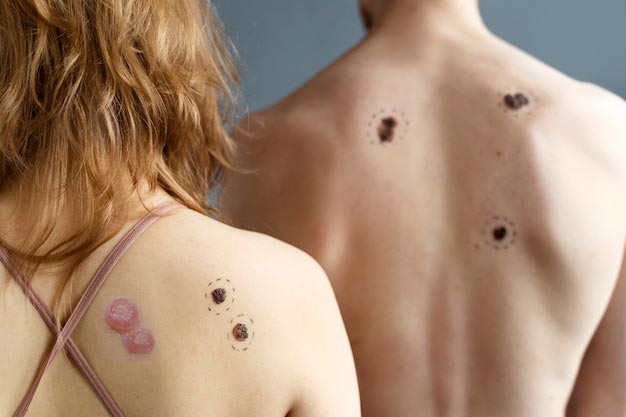
Different Types of Warts
Depending on the region, warts may look different. Let’s examine the six kinds of warts and identifying common warts.
- Common warts
So, how to identify common warts? Common warts have a rough, solid surface that could make you think of a cauliflower. Dark patches, the blood vessels beneath your skin, might appear on a typical wart. Although this kind of wart can develop anywhere, it frequently occurs on knuckles, fingers, elbows, knees, or other places where skin is damaged.
- Flat Warts
The flat look of flat warts, sometimes called plane warts, is not surprising. These spherical, smooth warts appear on skin exposed to the sun. The hue of flat warts can range from yellow to brown or even match your skin tone. Although flat warts frequently increase, they usually go away on their own relatively fast.
- Planter Warts
High-pressure zones are where plantar warts develop. The bottom of the foot, the toes, and the heels are among these places. A little black dot may be encircled by more rigid tissue in plantar warts.
- Filiform Warts
On the nose, eyes, or lips, filiform warts might develop. Because these warts develop into long, thin skin projections, they have a unique look. Avoid using at-home treatments and, instead, have our staff remove filiform warts since they increase in sensitive regions.
- Periungual and Subungual Warts
Wart form grows under and around the nail, both subungual and periungual. Compared to regular warts, these warts seem different.
Subungual warts are more challenging to cure because of their placement beneath a nail. Because they cause the surrounding skin to become elevated and ridged, these warts are also more painful than others.
Avoid picking or biting the affected nails to alleviate discomfort or eliminate the wart since this might spread the infection. Instead, please arrange an appointment to review treatment options with TheNationalSkinCentre specialists.
- Genitalia Warts
The symptoms of genital warts is that they develop in the moist areas of your genitalia and are nearly usually transmitted through sexual contact. You should know that symptoms of genital warts quite often do not cause pain and are too small to be seen, but sometimes, they may cause other uncomfortable feelings such as redness, itching, and skin rash.
Genital warts are caused by HPV, which comes in a variety of forms, the most of which are not harmful. It is perhaps one of the most pervasive illnesses, impacting millions of people worldwide. Nonetheless, women should get routine pap screenings, mainly if they test positive for HPV, as some virus strains may become cancerous.
Treatment for warts
Warts often do not indicate a severe medical condition and go away alone. It might take months or even years, though.
Most warts don’t hurt, but depending on where they are, such as on the bottom of your foot or finger joint, they could.
The type and location of warts determine the available wart removal options. The National Skin Centre experts assess your symptoms to suggest effective wart treatments. Options for treatment include:
- Freezing the wart is known as cryotherapy.
- Curettage (removing the wart with a scraper)
- Excision (the removal of the wart)
- Electrosurgery (wart burning)
- Applying or injecting medicine to eradicate the wart
Get in touch with The National Skin Centre right now to find out more about wart prevention tips and available treatments.
FAQs
Q: Which warts are the most widely recognized?
A: Typical warts, level warts, plantar warts, filiform warts, periungual/subungual warts, and genital warts are among the normal assortments.
Q: How might I perceive commonplace warts?
A: The outer layer of normal warts is generally unpleasant, much of the time looking like cauliflower, and may have dark regions due to veins.
Q: Do warts spread without any problem?
A: Without a doubt, most of wart types — especially those bought on by the HPV infection — are transferable and may spread through close contact.
Q: Could warts at any point vanish without help from anyone else?
A: Numerous warts disappear all alone, in spite of the fact that it could require months or even years. The cycle can be advanced by clinical mediations.
Q: What choices we have to treat warts?
A: Cryotherapy, curettage, extraction, electrosurgery, and prescription drugs are among the usable treatment.